How can investors profit from AI data centers without owning one?
Investors can profit from AI data centers without owning one by buying property near serious power, such as brownfields, power-adjacent land, contractor yards and electrified industrial outdoor storage. Carson's view is that power, not land, is now the scarcest input, so these sites can either be converted into data center candidates or support nearby projects by staging equipment and materials.
Key takeaways
- Sites close to heavy power have two paths: convert into a data center candidate or sale, or support nearby projects with storage, staging and service space.
- Every megawatt of compute needs transformers, switchgear, batteries and cooling stored, staged, assembled, moved and serviced, which drives demand for IOS and laydown yards.
- Many former plants and brownfields already have heavy power, industrial zoning, utility infrastructure, transport access and large land assemblies near labor.
- Electrified IOS adds high-capacity power, security, lighting, trailer power and equipment charging to a traditional fenced yard, with a different rent profile.
- xAI's Colossus buildout created demand in Memphis for power-adjacent land, staging yards, logistics space and IOS, illustrating what proximity to power does to a market.
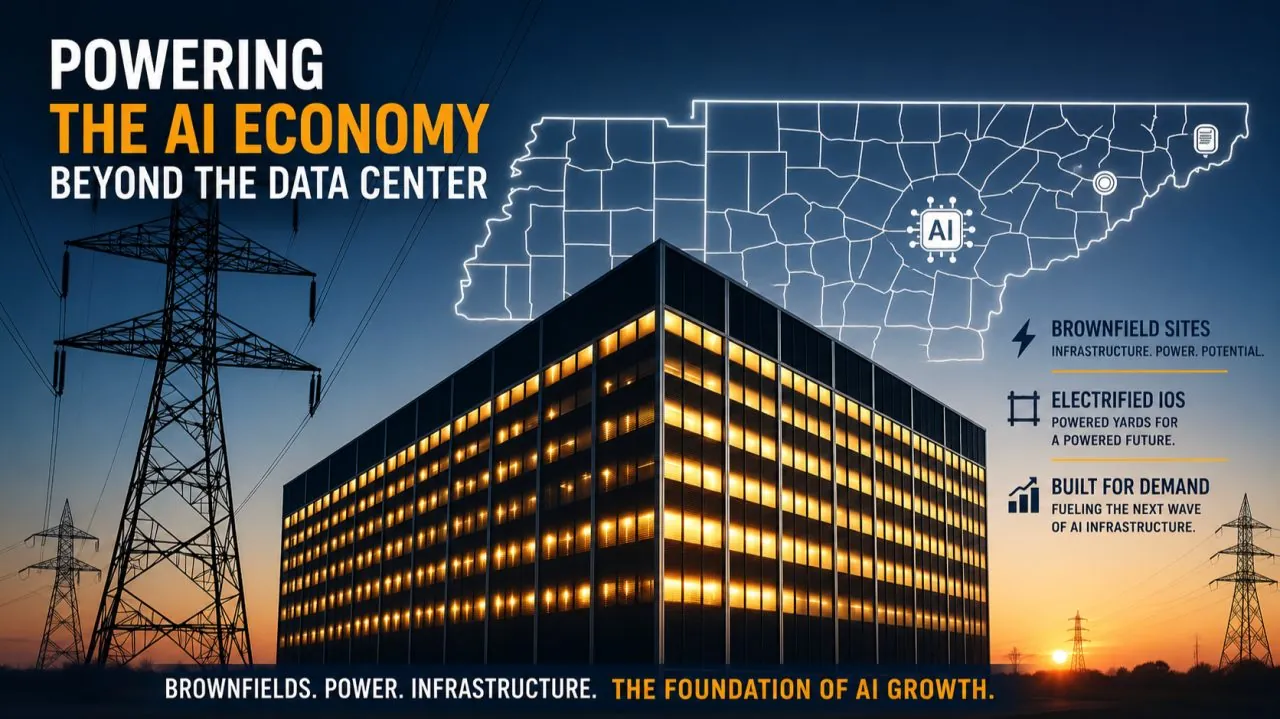
Why Power Access Now Drives Industrial Site Value
For decades, real estate followed rooftops, then population. Today the smart money follows megawatts.
The AI boom is the largest industrial buildout in modern history. And the single hardest thing to find isn't land — it's power. That one shift is rewriting what an industrial site is worth.
Two Ways to Profit from Sites Near Power: Convert or Support
When a property sits close to serious power, you have two ways to win.
1. Convert it. A site with heavy power, industrial zoning, and existing utility infrastructure isn't just land anymore — it's a candidate to become a data center, or to be sold to someone who will. Proximity to power is the whole game, and these sites already have it. A remediated brownfield can hit the market with advantages that would take years and millions to recreate on a greenfield.
2. Support it. Not every parcel becomes a data center — and it doesn't have to. Every megawatt of compute needs transformers, switchgear, batteries, and cooling stored, staged, assembled, moved, and serviced. That demand has to land somewhere physical. Industrial Outdoor Storage (IOS), contractor yards, and laydown space near these projects are suddenly mission-critical.
Same driver — power. Two ways to monetize it.
Why Brownfields Matter Again
Yesterday's industrial liabilities are today's critical infrastructure.
Former plants and brownfields carried a stigma — environmental concerns, aging buildings, obsolescence. But many sit on exactly what's now scarce: heavy power availability, industrial zoning, utility infrastructure, transport access, and large land assemblies near labor.
In a power-constrained market, those sites deserve a second look.
The Rise of Electrified IOS
Traditional IOS meant a fenced yard for trucks and equipment. The next evolution is Electrified IOS — high-capacity power, security, lighting, trailer power, equipment charging, and a completely different rent profile.
How xAI's Colossus Buildout Changed Industrial Demand in Memphis
xAI's Colossus buildout turned Memphis into one of the most watched industrial markets in America. Overnight, demand appeared for power-adjacent land, staging yards, logistics space, and IOS.
It's a preview of what proximity to power does to a market.
How Investors Can Own Part of the AI Buildout
Few of us will ever own a hyperscale campus. But many of us can own what makes one possible: power-adjacent land, brownfields, electrified IOS, contractor yards, and equipment staging.
The future of AI won't be built on pristine greenfields. It'll be built on America's industrial past — wherever the power already is.
I have a several industrial sites coming up in Memphis, message me if you are interested.
Disclaimer: The information provided is for educational and informational purposes only and should not be construed as investment, legal, tax, accounting, or financial advice. Opinions expressed are those of the author as of the publication date and are subject to change without notice. Readers should conduct their own due diligence and consult their own professional advisors before making any investment or business decisions.
Frequently Asked Questions about Brownfields, AI Data Centers and Electrified IOS
Why are brownfields attractive for AI data centers?
Many former plants and brownfields sit on what is now scarce: heavy power availability, industrial zoning, utility infrastructure, transport access and large land assemblies near labor. In a power-constrained market, a remediated brownfield can reach the market with advantages that would take years and millions of dollars to recreate on a greenfield site.
What is electrified industrial outdoor storage (IOS)?
Electrified IOS is the next evolution of industrial outdoor storage. Traditional IOS meant a fenced yard for trucks and equipment; electrified IOS adds high-capacity power, security, lighting, trailer power and equipment charging. That combination gives it a completely different rent profile from a conventional storage yard.
Why does the AI buildout increase demand for industrial yards?
Every megawatt of compute requires transformers, switchgear, batteries and cooling equipment that must be stored, staged, assembled, moved and serviced. That demand has to land somewhere physical, which makes industrial outdoor storage, contractor yards and laydown space near data center projects mission-critical even when the parcel itself never becomes a data center.
How did xAI's Colossus project affect Memphis real estate?
xAI's Colossus buildout turned Memphis into one of the most watched industrial markets in America. Demand quickly appeared for power-adjacent land, staging yards, logistics space and industrial outdoor storage. Carson treats Memphis as a preview of what proximity to power does to an industrial market.
What is power-adjacent land?
Power-adjacent land is property close to substations, high-voltage transmission or a retired plant's interconnection. It is valuable because it can become a data center candidate, or support nearby projects with staging, storage and service space.
How can I tell if my industrial site has data center potential?
Start with power: how far the site is from a substation or transmission line, and how much capacity the utility can deliver and when. Then check zoning, fiber, water and acreage. Sites that fall short of a data center can still capture demand as electrified IOS or equipment staging.
How much power does an electrified IOS yard need compared with a data center?
Far less. Electrified IOS needs enough service for trailer power, equipment charging, security and lighting — usually a fraction of what even a small data center draws. That is why a site that cannot support a data center may still be valuable as an electrified yard serving data center construction and operations nearby.
What is the difference between available and requested power on an industrial site?
Available power is capacity that is energized or contracted today — documented in a signed service agreement or a utility will-serve letter with a stated megawatt figure and date. Requested power is capacity someone has applied for or is studying in a queue; it is a possibility, not an asset, until the utility commits to it in writing. For electrified IOS, available service is what lets a yard command a rent premium on day one; requested service is a future upside a buyer will not pay full value for yet.
What utility documentation proves a yard or brownfield is electrified?
Current service agreements and bills showing the existing capacity, the transformer and switchgear ratings on site, the utility's written response on any upgrade request, and the distance to the nearest substation. For data center buyers, add a load study or will-serve letter stating megawatts and an in-service date.
How long does it take to energize an industrial yard versus a data center campus?
A service upgrade for a yard is typically measured in months; new large-load service for a data center is measured in years — this site's working figure is about four years on average for a new large-load connection in 2026. That gap is the opportunity: yards near announced campuses can earn power-adjacent rents long before the campus itself is energized.
Does fiber matter for power-adjacent industrial land?
Less for a yard than for a data center, but it still adds value. Fiber supports security, telematics and charging management on the yard, and nearby long-haul routes widen the buyer pool to include data center users if the site's power path improves.
What zoning does electrified IOS need near a data center campus?
Industrial zoning that permits outdoor storage, laydown and equipment staging, with any screening, paving and stormwater requirements the jurisdiction imposes. Some cities restrict outdoor storage in newer industrial districts, so confirm the permitted-use table before buying or marketing a yard.
How much usable acreage does a power-adjacent yard need?
Net usable acreage — after setbacks, stormwater ponds, easements and unusable slopes — is what tenants pay for. Laydown and staging users generally want contiguous, level, well-drained ground with truck access; a smaller fully usable site often outperforms a larger one broken up by easements.
Is power-adjacent land priced per acre or per megawatt?
Yards and IOS are priced per acre and by rent per acre. Per-megawatt pricing only applies when the site has documented, near-term capacity a data center buyer can use — at that point the land is competing in a different market.
How do buyers underwrite brownfield land near AI data centers?
They underwrite the base case as industrial or electrified IOS — rent per acre, surfacing and remediation cost, environmental liability — and treat any data center conversion as upside that only counts once the utility confirms megawatts and a date. Phase I results, existing service capacity and proximity to announced campuses drive the spread between the two cases.
Sources
- Lawrence Berkeley National Laboratory — Queued Up: 2025 Edition (December 2025)
- U.S. EPA — Brownfields and Land Revitalization
- U.S. EPA — Brownfields All Appropriate Inquiries (ASTM E1527-21 Phase I standard)
- Federal Energy Regulatory Commission — Docket RM26-4, Interconnection of Large Loads to the Interstate Transmission System
Figures described as working figures are this guide's own estimates; confirm megawatts, dates and costs for a specific site in writing with the serving utility.
Selling or buying commercial property? Let's talk.
Brokerage and equity participation for commercial real estate owners, investors, and family offices — worldwide, through the eXp Commercial platform.

Carson Jones
Carson Jones is the host of Carson's Corner: Commercial Real Estate, author of The Red Flag Playbook, a licensed commercial real estate advisor and business broker, and the founder of Passive Investments. With 18 years of experience as an entrepreneur and 12 years specializing in passive investing, Carson works with high-net-worth individuals, family offices, business owners, and sophisticated investors as a broker and principal.
Carson holds a BBA in Finance from Baylor University and his Tennessee commercial real estate license (#382989). He actively pursues acquisition and equity opportunities across the United States and abroad through a worldwide network of qualified buyers, family offices, institutional investors, and top-tier developers.
Pricing disclaimer. The $300,000–$600,000 per-MW figures used on this page are an illustrative pricing range, not a guaranteed valuation. Actual pricing depends heavily on confirmed power capacity, delivery timelines, utility costs, location, and development readiness.