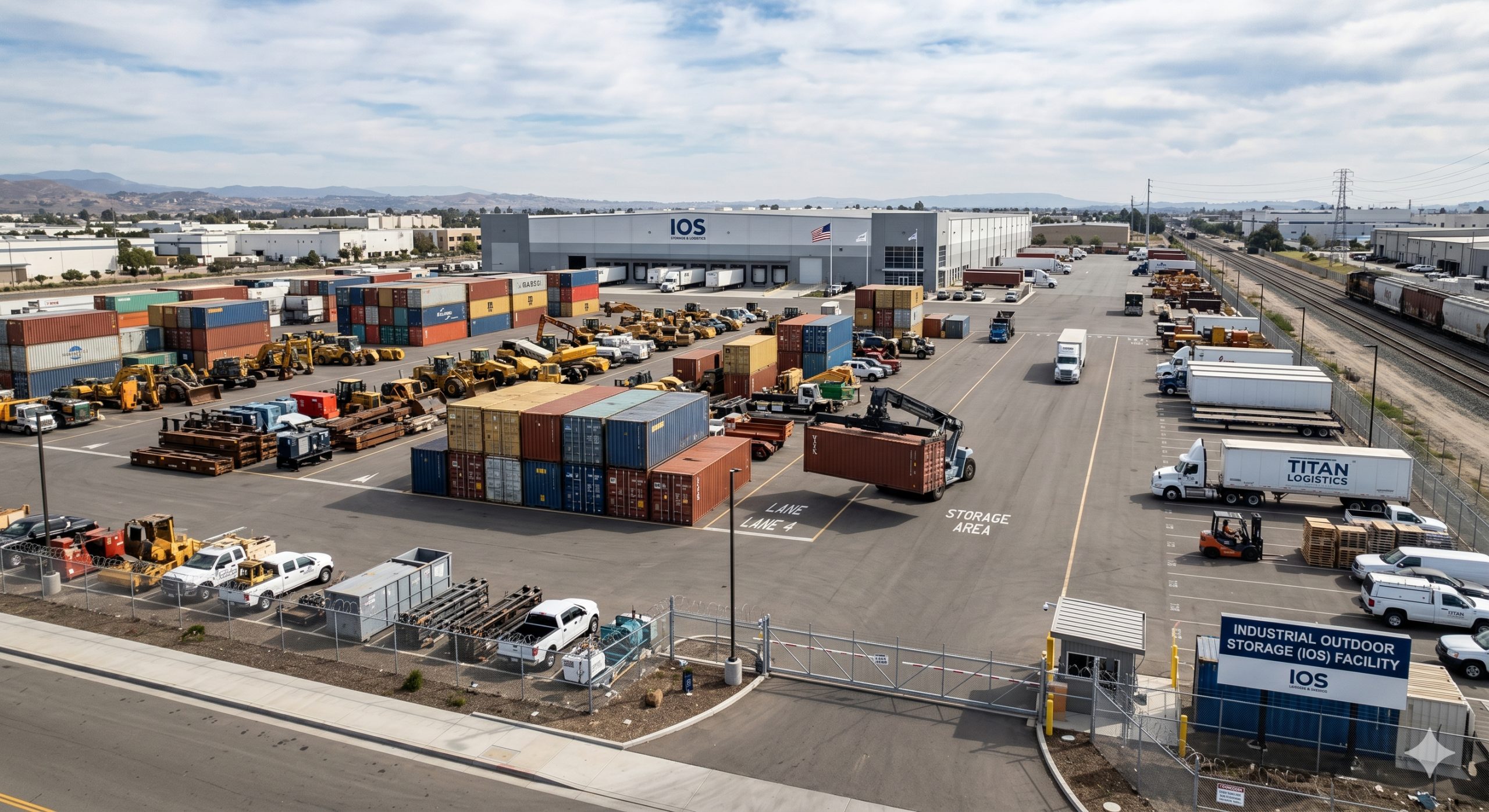
Executive Summary
For most of its history, industrial outdoor storage was the unglamorous back lot of commercial real estate — the gravel yard behind the warehouse, the truck lot off the highway, the contractor's fenced parcel full of pipe and equipment. Then institutional capital discovered that this overlooked corner had three rare qualities at once: durable, essential demand; chronic and worsening undersupply; and almost no construction or capital intensity. In a handful of years, IOS went from a use nobody underwrote to one of the most competitively bid niches in the entire industrial sector.
What IOS is
Industrial outdoor storage is real estate where the land itself is the product. Tenants pay to store trucks, trailers, shipping containers, construction equipment, vehicles, pipe, or materials outdoors on a stabilized, fenced, and secured yard. There is usually a building — a small office, a maintenance shop, sometimes a modest warehouse — but it is incidental. The defining trait is a low building-to-land coverage ratio, typically under 20 percent and often under 10 percent. Because the yard is the asset, IOS is leased, priced, and underwritten on a per-acre basis rather than a per-square-foot basis, and it behaves more like income-producing industrial land than like a conventional building.
Why investors are paying attention
Three forces converged. First, the long boom in e-commerce, logistics, and infrastructure spending created relentless demand for places to park trailers, stage containers, and store fleets and equipment near where goods move and work happens. Second, the supply of legally usable yard land has been shrinking: cities have downzoned industrial districts, banned new outdoor storage, and converted close-in industrial land to warehouses, housing, and retail. Third, IOS offers an unusually clean operating profile — minimal structures to maintain, low capital expenditure, simple leases, and the optionality of land that can be redeveloped later. Rising demand against a fixed-or-falling supply of an asset that is cheap to own is the textbook setup for rent growth and value appreciation, and investors noticed.
Why truck parking isn't the whole story
IOS is frequently summarized as "truck parking," and truck and trailer parking is indeed a major use. But reducing the asset class to parking misses most of the opportunity. IOS also encompasses container and intermodal storage, contractor and utility laydown yards, equipment and fleet storage, building-materials yards, vehicle storage, and the yard component of truck terminals. The tenants span trucking, construction, utilities, roofing, HVAC, paving, landscaping, equipment rental, and municipal fleets. The common thread is not trucks — it is the need for secure, accessible, legally permitted outdoor space. Owners who think only about over-the-road trucking overlook the contractors, utilities, and last-mile operators who often pay more and stay longer.
Who uses IOS
The tenant base is broad and tied to the physical economy: over-the-road and regional trucking companies; third-party logistics and last-mile delivery operators; utility contractors and the utilities themselves; roofing, HVAC, plumbing, electrical, paving, and landscaping contractors; general contractors and site-work firms; equipment rental businesses; container leasing and chassis operators; building-materials suppliers; auto, RV, and boat storage operators; and government and municipal fleets. This diversity is a feature. When demand is spread across trucking and construction and utilities and logistics, no single industry cycle controls the whole rent roll.
Risks and opportunities
The opportunity is structural: an essential-use asset with a shrinking supply, low operating complexity, and embedded land value. The risks are real but largely diligence-driven — environmental contamination from prior industrial use, tenant concentration, municipal and neighbor opposition, surface and drainage deterioration, and sensitivity to the freight and construction cycles. The investors who win in IOS are the ones who treat entitlement and environmental work as the heart of the deal, diversify their tenancy, buy durable locations that cannot easily be replicated, and avoid overpaying at the top of a hot market. The chapters that follow build the full playbook, starting with precise definitions and ending with a 100+ question FAQ and a stack of practical checklists.
Chapter 1 — What Is Industrial Outdoor Storage?
Industrial outdoor storage is a category of industrial real estate in which usable, stabilized open land — the yard — is the primary income-producing asset, and any buildings are secondary. An IOS property is, in essence, a securely fenced, well-drained, durably surfaced parcel where businesses store rolling stock, containers, equipment, and materials outdoors. The economics, the leasing, and the valuation all flow from that simple fact: you are renting ground, not enclosed space.
The most useful technical definition centers on the coverage ratio — the share of the site occupied by building footprint. Conventional industrial buildings cover 40 to 60 percent or more of their parcels. IOS sits at the opposite end: building coverage is usually below 20 percent, and the most "pure" IOS assets are under 10 percent, with the balance as leasable yard. A 5-acre site with a 10,000-square-foot shop covers roughly 5 percent of its land; the other 95 percent is the asset. That low-coverage profile is what separates IOS from a warehouse with a parking lot.
The vocabulary of the yard
IOS is described with a handful of overlapping terms, and understanding the distinctions helps you speak the language of brokers, lenders, and tenants:
Industrial Outdoor Storage (IOS)
The umbrella term for low-coverage industrial land leased for outdoor storage of vehicles, trailers, containers, equipment, or materials. It is the institutional label that pulls all the sub-uses below under one asset class.
Trailer storage
Yards used to park semi-trailers, drop trailers, and chassis for trucking companies, shippers, and logistics providers. Trailer storage is often leased by the stall or by the acre and clusters near highway interchanges and distribution hubs where carriers need to stage equipment between loads.
Container storage
Yards used to store shipping containers — empty or loaded — for ocean carriers, intermodal operators, container-leasing firms, and importers. Container storage is surface-intensive because containers are often stacked, which concentrates heavy point loads and pushes operators toward concrete or heavy asphalt and strong drainage.
Equipment yards
Sites where heavy equipment — excavators, loaders, cranes, lifts, generators, and attachments — is stored and staged by equipment rental companies, contractors, and fleet owners. Equipment yards frequently pair outdoor storage with a maintenance shop and fuel, and value secure perimeters because the stored assets are valuable and portable.
Contractor yards
The classic IOS use: a fenced parcel, usually with a small office or shop, where a construction, utility, roofing, HVAC, paving, or landscaping firm stores trucks, trailers, equipment, pipe, and materials close to its job market. Contractor yards anchor much of the multi-tenant IOS world and tend to feature sticky, renewing tenants who are hard to relocate.
Truck terminals
Cross-dock buildings where freight is transferred between trucks, wrapped by extensive trailer parking and maneuvering yard. Terminals are a building-plus-yard hybrid; the yard component is pure IOS, and the asset class increasingly overlaps as logistics operators value the parking as much as the dock doors.
Fleet storage
Yards where companies park and stage fleets of trucks, vans, buses, service vehicles, or specialty equipment overnight and between shifts. Fleet storage has grown sharply with e-commerce delivery, utility expansion, and municipal operations, and it favors infill locations close to routes and crews.
Example tenants and how they use the yard
Utility contractors
Store bucket trucks, digger derricks, reels of cable and conduit, poles, transformers, and trailers; need secure, accessible space near service territories and storm-response staging.
Roofing companies
Stage trucks, trailers, dumpsters, material lifts, and bulk roofing materials; value yards near dense residential and commercial work and quick highway access.
HVAC companies
Park service vans and box trucks, store rooftop units, ductwork, and equipment; favor infill fleet-storage yards close to crews and customers.
Construction firms
Use yards as laydown and staging for equipment, formwork, pipe, rebar, and trailers; demand rises and falls with the building cycle and infrastructure work.
Transportation companies
Park tractors and trailers, drop and hook, and stage containers; cluster near interstates, ports, rail, and distribution centers.
Equipment rental businesses
Store and service rental fleets — lifts, generators, compaction, earthmoving; pair yard with shop, fuel, and wash, and prize visibility and security.
Across all of these, the tenant is buying the same thing: secure, well-located, legally permitted ground they can drive heavy vehicles onto and store valuable assets on. That is the whole product. Everything in the rest of this guide — site selection, zoning, surfacing, valuation, financing — is in service of delivering and protecting that simple proposition.
Chapter 2 — Why IOS Became One of CRE's Hottest Asset Classes
The repricing of industrial outdoor storage was not a fad; it was the market catching up to a structural imbalance. Demand for outdoor storage rose steadily for a decade while the supply of legally usable yard land was actively shrinking. When a durable, essential use meets a contracting supply, rents rise, vacancy falls, and capital floods in. Here are the forces that combined to make it happen.
E-commerce growth
The shift of retail spending online rebuilt the entire logistics map. Every package ordered online has to be received, sorted, staged, and delivered, and that physical choreography requires far more trailers, containers, vans, and staging yards than the store-based economy it replaced. E-commerce did not just fill warehouses; it filled the land around them with trailers waiting to be loaded and delivery fleets waiting to roll. Outdoor storage is the connective tissue of that network, and as online penetration climbed, so did the need for yards in and around population centers.
Supply chain changes
Recent years taught shippers a hard lesson about lean inventory. The pendulum swung from "just in time" toward "just in case," with companies holding more buffer inventory, more containers, and more equipment closer to demand to insulate themselves from disruption. More inventory and more containers in the system means more places to put them when they are not moving. Reshoring and the reorganization of trade routes added regional staging needs. All of it lands, literally, on outdoor storage yards.
Land scarcity
This is the supply side of the story, and it is decisive. Industrial land near population centers is finite and increasingly contested. Warehouse developers, homebuilders, and retailers all bid for the same close-in parcels, and they usually outbid a truck yard on a per-square-foot basis — at least until you account for what is permitted. Meanwhile cities have downzoned industrial districts and restricted outdoor storage. The result is that the pool of land where you can legally run a yard near where goods move is shrinking even as demand grows. Scarcity is the engine under IOS values.
Industrial rent growth
The broader industrial sector experienced years of strong rent growth, and IOS rode the same wave while offering a cheaper way to participate. As warehouse rents climbed, the yards that serve and surround those warehouses gained pricing power too. Tenants who could not justify or could not find warehouse space found that an outdoor yard delivered most of what they needed — security, access, proximity — at a fraction of the occupancy cost, which sustained demand for yards even as overall industrial costs rose.
Infrastructure spending
Large public and private infrastructure programs — roads, bridges, water, broadband, the electric grid, and energy projects — translate directly into demand for contractor and equipment yards. Infrastructure work is laydown-intensive: it requires places to stage pipe, cable, poles, aggregate, equipment, and crews near the work. Sustained infrastructure investment puts a long-duration floor under contractor-yard demand in many markets, and it tends to be less correlated with consumer cycles than e-commerce-driven trailer demand.
Trucking demand
Trucking moves the overwhelming majority of domestic freight, and trucks and trailers have to be parked somewhere when they are not on the road. The country has a well-documented, chronic shortage of truck parking, and trailer staging needs have grown with drop-and-hook logistics and larger fleets. Every distribution center generates demand for nearby trailer storage. Because the parking shortage is structural and slow to fix, trailer and truck storage enjoys persistent, location-driven pricing power in the right markets.
Contractor consolidation
The trades are consolidating. Private equity and strategic buyers have been rolling up HVAC, roofing, plumbing, electrical, landscaping, and utility-services companies into larger regional and national platforms. Consolidated operators run bigger fleets, hold more equipment, and need larger, more professional yards — and they increasingly prefer to lease purpose-suited IOS from institutional owners rather than scatter trucks across small owned lots. That professionalization of the tenant base has made contractor-yard income more creditworthy and more institutionally financeable.
Chapter 3 — Understanding IOS Property Types
"IOS" is a single label over a surprisingly varied set of property types, each with its own tenants, surface and security needs, lease structures, and demand drivers. Understanding the sub-types helps you match a site to its best use, underwrite the right tenant base, and avoid buying the wrong yard for your market.
Truck parking
Dedicated parking for tractors and, often, drivers' personal vehicles, plus over-the-road trucks staging between loads. Truck parking thrives near interstates, fuel and rest corridors, ports, and large distribution clusters. It can be leased by the space monthly or to fleet operators by the acre. Because the national truck-parking shortage is acute, well-located truck parking enjoys strong, durable demand, though it requires good ingress and egress for large vehicles and tolerant neighbors.
Trailer parking
Storage and staging of semi-trailers and chassis, frequently in drop-and-hook operations where carriers leave loaded or empty trailers to be swapped. Trailer parking is the workhorse of IOS near distribution centers and intermodal facilities. It is surface-sensitive — landing gear and heavy trailers can punch through weak pavement — and rewards yards with efficient layouts that maximize stalls per acre.
Equipment storage
Yards for heavy construction and industrial equipment, often combined with a maintenance shop, fuel, and wash facilities. Equipment storage demands robust security because the stored assets are valuable and mobile, and it values durable surfaces and good drainage to handle tracked machines and point loads. Tenants include contractors, equipment rental firms, and specialty trades.
Contractor yards
The multi-tenant and single-tenant home of the trades: fenced parcels, usually with a modest office or shop, used by construction, utility, roofing, HVAC, paving, and landscaping firms. Contractor yards are the deepest, most diversified slice of IOS demand. They tend to feature loyal, renewing tenants who are expensive to relocate, which supports occupancy and rent stability, and they are often the most management-light when leased net.
Intermodal storage
Container and chassis storage that supports rail-to-truck transfer near intermodal terminals. Intermodal storage clusters tightly around rail ramps and benefits from container volumes that flow through the rail network. It is surface- and stacking-intensive, often requiring concrete or heavy asphalt, strong drainage, and equipment like reach stackers, and it favors large, well-configured sites with rail proximity.
Port-adjacent IOS
Among the most valuable IOS anywhere: container, chassis, and drayage-truck storage in the supply-constrained land around major seaports. Port-adjacent yards serve ocean carriers, drayage operators, and importers who must stage containers near the terminal. Because developable land near ports is extremely scarce and expensive, port-adjacent IOS commands premium rents and trades at aggressive pricing, but it is also more exposed to trade and shipping cycles.
Last-mile IOS
Vehicle parking and small-container staging close to dense population centers to support final-mile delivery and service fleets. Last-mile IOS is driven by e-commerce delivery, home services, and the need to position vans and box trucks near customers to compress delivery times. Infill scarcity makes these yards expensive to assemble and highly prized; even small parcels can be valuable if zoned and located right.
Utility service centers
Operating yards for electric, gas, water, telecom, and broadband utilities and their contractors, storing service vehicles, materials, poles, cable, pipe, and storm-response equipment. Utility service centers tie to long-duration grid, water, and broadband investment, often involve creditworthy or quasi-public tenants, and tend to be sticky because relocating a utility operating base is disruptive and costly.
| Property type | Primary tenants | Surface intensity | Key location driver |
|---|---|---|---|
| Truck parking | Carriers, owner-operators | Moderate | Interstates & corridors |
| Trailer parking | Carriers, 3PLs, shippers | Moderate–High | Distribution clusters |
| Equipment storage | Contractors, rental firms | High | Job markets, security |
| Contractor yards | Trades, utilities, GCs | Low–Moderate | Proximity to work |
| Intermodal storage | Rail, container operators | High | Rail ramp proximity |
| Port-adjacent | Ocean carriers, drayage | High | Seaport proximity |
| Last-mile | E-commerce, home services | Low–Moderate | Population density |
| Utility service center | Utilities & contractors | Moderate | Service territory |
Own a yard — or hunting for an IOS site?
Carson Jones is a licensed commercial real estate advisor and business broker with eXp Commercial. If you own a contractor yard, truck or trailer lot, or low-coverage industrial land, or you're sourcing IOS to buy, get a straight read on what your site is worth, what it can be entitled for, and who's buying.
Chapter 4 — What Makes a Great IOS Site?
This is the chapter where investors win or lose money, because the qualities of the dirt and its entitlement determine almost everything about an IOS deal. A great IOS site is one that is hard to replicate, legally permitted, physically suited to heavy use, and positioned where tenants need to be. Below are the variables that matter, roughly in order of importance.
Location
Location is the first and largest value driver in IOS, just as it is in most real estate — but here it is specifically about proximity to the flow of goods and the work tenants perform. A yard's value is set by how close it is to the highways, ports, rail, distribution centers, dense population, and construction activity that its tenants serve. Two physically identical yards can differ in value by multiples based purely on location. Location is also what makes a site defensible: a well-placed infill yard surrounded by incompatible uses cannot be reproduced nearby, which protects its rents.
Highway access
For trucking and trailer uses especially, fast, easy access to interstates and major arterials is essential. Tractor-trailers need routes that can handle their turning radii and weight, intersections and ramps they can navigate, and ideally a location that avoids residential streets and weight-restricted roads. A yard a mile from an interchange on a truck route is worth far more to a carrier than one buried behind neighborhoods, even if it is closer as the crow flies.
Visibility
Visibility matters more for some uses than others. Equipment rental, vehicle storage, and businesses that draw walk-in or drive-by demand value frontage and signage. For pure trailer and container storage leased to logistics operators, visibility is less important than access and security. Visibility can also cut the other way — a highly visible yard can attract code complaints and neighbor scrutiny, so it interacts with the zoning and screening picture.
Zoning
Zoning is so central to IOS that it gets its own chapter, but it belongs in any list of what makes a great site because it is frequently the difference between a usable yard and worthless dirt. The best IOS sites carry zoning that permits outdoor storage as-of-right or are legally grandfathered, in jurisdictions that are unlikely to take that right away. Entitlement is often the single largest component of an IOS site's value precisely because it cannot be manufactured where municipalities have closed the door.
Utilities
IOS is not utility-intensive compared with buildings, but the site still needs adequate power for lighting, gates, and security; water and sewer or septic for any office or shop; and telecom for operations and cameras. Some tenants — equipment yards with shops, fleet operations with fueling and washing — need more robust utility service. Confirming that utilities are present and adequate, and that any required upgrades are feasible and affordable, is part of site quality.
Drainage
Drainage is one of the most underrated determinants of an IOS site's quality and long-term cost. A yard that ponds water, floods, or holds moisture under its surface will deteriorate quickly, frustrate tenants, and invite environmental and code problems. Good sites shed water through proper grading and stormwater management without creating runoff or pollutant-discharge issues. Poor drainage is expensive to fix and can quietly destroy the surface investment, so it deserves real scrutiny.
Security
Tenants store valuable, portable assets — trucks, equipment, containers — outdoors, so security is fundamental to the product. A great site supports a secure perimeter and is in a location where theft and vandalism are manageable. Security is both physical (fencing, gates, lighting, cameras) and locational (the surrounding area's risk profile). Strong security supports higher rents and lower tenant turnover; weak security caps both.
Access control
Closely related to security, access control is how the yard manages who comes and goes — manned or automated gates, key or code or credential systems, and the ability to restrict and log access. Professional tenants, especially logistics and equipment operators, increasingly expect controlled, monitored access. Good access control also reduces liability and helps with insurance.
Surface type
The yard surface is the major physical capital decision in IOS, and the right choice depends on the intended use, the loads, the climate, and the budget. The surface determines how much rent the yard can command, how much maintenance it needs, and how heavy a use it can support. Here is how the common options compare:
| Surface | Up-front cost | Durability / load | Best for | Trade-offs |
|---|---|---|---|---|
| Gravel (compacted) | Lowest | Low–Moderate | Overflow, light trailer & equipment storage | Ruts, dust, migration, ongoing regrading; may cap rent and face stormwater scrutiny |
| Crushed stone | Low | Moderate | Trailer and equipment yards on a budget | Periodic replenishment; less precise drainage; can limit container stacking |
| Asphalt | Higher | High | Trailer parking, drive aisles, mixed use | Softens in heat under point loads; needs sealing and periodic resurfacing |
| Concrete | Highest | Highest | Container stacking, heavy point loads, intermodal | Most expensive; longer install; cracking if poorly built; hardest to modify |
In practice, many strong yards mix surfaces: concrete or heavy asphalt where containers stack and equipment maneuvers, standard asphalt on drive aisles, and crushed stone or gravel on overflow areas. The surface decision should follow the tenant strategy and the loads, not the other way around — paving a gravel-grade yard to concrete only pays if a tenant will pay for it.
Chapter 5 — IOS Site Selection
Site selection is where the location principles of the previous chapter become a repeatable screen. The best IOS owners do not chase individual listings; they form a thesis about where demand is strong and supply is constrained, then hunt for parcels that fit. The following criteria drive that hunt.
Interstate proximity
For trucking, trailer, and logistics uses, proximity to the interstate system is the dominant locational variable. Sites within a few minutes of an interchange, on roads built for heavy trucks, capture carriers and 3PLs who measure their world in drive time and fuel. The closer and easier the highway connection, the deeper the tenant pool and the higher the achievable rent. Selection should map candidate parcels against interchanges and designated truck routes, not just road frontage.
Port proximity
Near major seaports, land suited to container, chassis, and drayage storage is among the most valuable IOS in the country because developable land is so scarce and container volumes so large. Port-adjacent selection is about being inside the practical drayage radius of the terminal while holding zoning that permits container storage. The premium is real, but so is the cyclicality, so port-adjacent selection should weigh both the scarcity upside and the trade-cycle exposure.
Rail access
Proximity to rail and intermodal terminals creates demand for container and chassis storage tied to rail volumes. Some IOS sites have direct rail service, which can be valuable for certain tenants, but for most IOS the relevant factor is being near an intermodal ramp where container flows generate storage need. Rail-adjacent sites can also serve bulk and materials uses. Selection should identify ramp locations and the storage demand they throw off.
Industrial employment
Markets with deep, growing industrial and logistics employment generate sustained demand for yards. A large base of trucking, distribution, manufacturing, and construction activity means a large, renewing pool of tenants who need outdoor storage. Tracking industrial employment, distribution-center development, and trade volumes helps identify markets where IOS demand is durable rather than speculative.
Population growth
Population and household growth drive consumption, construction, and last-mile delivery — all of which create IOS demand. Growing metros need more goods delivered, more homes and infrastructure built, and more service fleets deployed, which feeds trailer, contractor, and fleet-storage demand. Population growth also tends to push residential and commercial development into former industrial land, tightening yard supply even as it raises demand — a double benefit for owners of entitled yards.
Logistics corridors
Beyond individual interchanges and ports, whole regions function as logistics corridors — the distribution belts and freight crossroads where a disproportionate share of goods move. Siting IOS within or feeding these corridors aligns the asset with the heaviest, most durable flow of freight and the densest cluster of carriers and 3PLs. Corridor-level thinking helps owners buy in front of demand rather than chasing it after rents have already moved.
Chapter 6 — Zoning & Entitlements
If location sets an IOS site's ceiling, zoning sets whether you can use the site at all — and it is the chapter that separates experienced IOS investors from newcomers. In most markets, the scarcity that drives IOS values is created not by a shortage of dirt but by a shortage of dirt where outdoor storage is legal. Entitlement is therefore both the largest risk and the largest source of value in the asset class.
Heavy industrial
Heavy industrial zoning (often designated M-2, I-2, or similar) is the most permissive category and the natural home of IOS. It typically allows outdoor storage, truck parking, contractor yards, and equipment storage as permitted uses, sometimes with screening or buffering conditions. A site in a heavy industrial district that allows outdoor storage as-of-right is the gold standard because the right to operate the yard is secure and not dependent on discretionary approvals.
Light industrial
Light industrial zoning (M-1, I-1) is more restrictive. It may permit outdoor storage only as an accessory use, only with screening, or only through a conditional or special use permit — or it may prohibit it outright. Many newcomers assume "industrial zoning" means they can run a yard; in light industrial districts that assumption can be wrong. Always read the specific code, not the general label, and confirm outdoor storage is a permitted or conditionally permitted principal use.
Conditional uses
In many jurisdictions, outdoor storage is allowed only as a conditional use or special exception, meaning it requires a discretionary public approval — a hearing, conditions, and the risk of denial. Conditional-use entitlement adds time, cost, and uncertainty, and approvals can come with conditions (hours, screening, surfacing, traffic) that affect economics. A site that already holds its conditional-use permit is worth more than one that must still obtain it, and a value-add thesis built on winning a conditional use must price the risk of losing it.
Outdoor storage restrictions
Even where outdoor storage is permitted, codes frequently restrict what can be stored, how high, and how much of the site it can occupy. Some prohibit storing certain materials, cap stacking height (a critical issue for container yards), limit the storage area as a percentage of the lot, or require that storage be set back from property lines and streets. These restrictions directly affect how many trailers, containers, or pieces of equipment a yard can hold, and therefore its income.
Truck parking restrictions
Truck and trailer parking draws specific regulatory attention because of its traffic, noise, and aesthetic impacts. Some jurisdictions limit the number of trucks, restrict overnight parking, require specific ingress/egress and on-site circulation, or prohibit truck parking near residential areas. Because truck parking is both in high demand and frequently targeted by restrictions, an entitled, unrestricted truck-parking site is especially valuable — and an investor must confirm exactly what the code permits before underwriting truck income.
Noise requirements
Outdoor operations generate noise — backup alarms, engines, refrigerated container units, equipment — and many codes impose noise limits, especially near residential or mixed-use areas and at night. Noise requirements can constrain operating hours and tenant types and can be the basis for neighbor complaints and enforcement. Understanding the applicable noise rules, and the site's buffer from sensitive neighbors, is part of entitlement diligence.
Screening requirements
To soften the visual impact of yards, jurisdictions commonly require screening — solid fencing, walls, berms, or landscaping — around outdoor storage, sometimes tall enough to hide stored materials and stacked containers. Screening can be a meaningful capital cost and can limit how the yard is used and how high materials can be stacked behind it. Required screening also signals a jurisdiction that tolerates yards only reluctantly, which is a flag for future restriction risk.
The practical takeaway: never underwrite IOS income you are not certain is legal. Order a zoning report, get a written zoning verification or letter from the municipality, confirm the legal status of any non-conforming use, and understand the political direction of the jurisdiction. The yards that hold their value are the ones whose right to exist cannot easily be taken away.
Chapter 7 — IOS Operations
One of IOS's great attractions is operational simplicity. With few or no buildings, there are no roofs to replace, no HVAC to service, no elevators, and minimal tenant-improvement work. But "simple" is not "nothing," and well-run yards out-earn poorly run ones. Here is what operating an IOS asset actually involves.
Tenant management
IOS tenants range from a single national logistics operator on a long net lease to a dozen local contractors on shorter, gross or modified-gross terms. Tenant management is about credit, lease structure, and retention. Net leases — where tenants pay taxes, insurance, and maintenance — minimize landlord operating burden and are common on single-tenant and larger yards. Multi-tenant yards require more active management but spread risk across many tenants. Strong owners screen credit, structure leases to pass through costs and capture growth, and work to retain sticky tenants whose relocation costs make them likely to renew.
Security
Because the product is secure outdoor space, security is core operations, not an afterthought. Effective security blends a hardened perimeter, controlled access, lighting, surveillance, and sometimes on-site presence or remote monitoring. Security drives both rent (tenants pay for safety) and risk (theft, vandalism, and liability). Investing appropriately in security typically pays for itself through higher rents, lower turnover, and reduced losses.
Cameras
Camera systems — increasingly with remote monitoring, analytics, and license-plate recognition — have become a standard expectation, especially for equipment and logistics tenants storing valuable assets. Good camera coverage deters theft, supports access logging and incident resolution, can lower insurance costs, and is relatively inexpensive to deploy and maintain compared with the value it protects.
Fencing
Perimeter fencing defines the yard, controls access, and provides the first layer of security; in many jurisdictions it also satisfies screening requirements. Fencing choices range from chain link with privacy slats or barbed/razor wire to solid walls and gated entries. Fencing is a modest capital item with outsized impact on security, screening compliance, and tenant confidence, and its condition is a standard inspection point.
Gate systems
Gates — manual, electric, or fully automated with credentials — manage and log who enters and exits. Automated gate systems with access cards, codes, or app credentials are increasingly expected by professional tenants and reduce staffing needs. Reliable gates are essential to the access-control value proposition and are a common source of tenant friction when they fail, so maintenance matters.
Access control
Beyond the physical gate, access control is the system of policies and technology that governs entry: who has credentials, when they can enter, how access is logged, and how it is revoked. For multi-tenant yards, access control also keeps tenants out of each other's space. Modern, auditable access control supports higher rents, better security, and cleaner operations, and it is becoming a differentiator between institutional-grade and informal yards.
Stormwater
Large paved or graveled surfaces generate stormwater runoff, and managing it is both an operational and a regulatory responsibility. Yards often need stormwater permits, detention or treatment systems, and maintenance of drainage infrastructure to prevent ponding, erosion, and pollutant discharge. Neglected stormwater management causes surface failure, regulatory exposure, and tenant complaints, so it belongs in every operating budget and inspection cycle.
Maintenance
IOS maintenance centers on the surface and the systems that protect it: crack sealing and resurfacing asphalt, regrading and replenishing gravel, maintaining drainage and stormwater systems, repairing fencing and gates, servicing lighting and cameras, controlling vegetation and dust, and keeping any office or shop functional. Maintenance is far lighter than for buildings, but deferring surface and drainage work is the fastest way to erode an IOS asset's value, so disciplined preventive maintenance is the operating heart of a well-run yard.
Chapter 8 — IOS Valuation
Valuing IOS blends conventional income-property analysis with land-based metrics, because the asset is part income stream and part scarce land. The most reliable approach triangulates several methods rather than relying on any single one. Here are the tools and how they fit together.
Price per acre
Price per acre is the headline metric in IOS, expressing the purchase price relative to the land area. It allows quick comparison across deals and against alternative industrial land values, and it grounds the analysis in the scarce resource at the center of the asset. The key refinement is to use price per usable acre — the leasable, drivable area after setbacks, drainage, easements, and unusable ground — because gross acreage can badly overstate what actually produces income.
Rent per acre
Rent per acre (or per usable acre) is the income counterpart to price per acre and the primary way IOS income is benchmarked. It lets owners compare a yard's pricing power across sites and submarkets and gauge whether in-place rents are above or below market. Rising rent per acre in a submarket is the clearest signal of the supply-demand imbalance that drives IOS value, and the gap between in-place and market rent per acre defines much of the value-add opportunity.
Rent per space
For truck and trailer parking, rent is often quoted and analyzed per parking space or stall per month rather than per acre. Rent per space is intuitive for parking-oriented yards and ties directly to the layout efficiency of the site — how many usable stalls fit per acre. Converting between rent per space and rent per acre (via stalls per acre) is a routine analytical step and helps compare parking yards against acreage-leased yards.
Cap rates
The income approach capitalizes net operating income at a market capitalization rate to estimate value: value equals NOI divided by the cap rate. Cap rates for IOS vary with location quality, tenant credit, lease term and structure, and the prevailing interest-rate environment. Well-located, leased, lower-risk IOS commands lower cap rates (higher values), while smaller, multi-tenant, value-add, or weaker-location yards trade at higher cap rates. Because IOS cap rates move with capital markets and are thinly traded in some submarkets, they must be checked against current comparable sales rather than assumed.
Replacement cost
Replacement cost asks what it would cost to recreate the asset — acquire comparable land, entitle it, and build the surface, fencing, drainage, and improvements. In IOS, the most important insight from replacement-cost analysis is that the land and especially the entitlement often cannot be replaced at any price in supply-constrained markets, because the jurisdiction will not permit a new yard. That irreplaceability is precisely why entitled yards can trade above the cost of their physical improvements and why replacement cost sets a meaningful floor in markets where new supply is still possible.
Land value
Underlying every IOS valuation is the land's value for its highest and best use. Sometimes the yard income is the highest and best use; sometimes the land is worth more for future warehouse, retail, or residential development, giving the owner valuable optionality and a downside floor. Because IOS carries little building value to depreciate or to become obsolete, its worth is anchored in land and entitlement — which supports value retention and gives owners a menu of exits: hold for income, sell to a user, or redevelop.
| Method | What it answers | Best used for |
|---|---|---|
| Income / cap rate | What the cash flow is worth today | Stabilized, leased yards |
| Price per usable acre | How the deal compares to land & peers | All IOS; cross-check |
| Rent per acre / per space | Pricing power vs. market | Benchmarking & value-add gaps |
| Replacement cost | Cost to recreate (if even possible) | Supply analysis & value floors |
| Underlying land value | Downside floor & redevelopment upside | Optionality & exit planning |
The disciplined approach is to run the income method for the operating value, cross-check against price and rent per usable acre and recent comparable sales, sanity-test against replacement cost and underlying land value, and then reconcile the methods into a value range. Relying on any single metric — especially a thin set of cap-rate comps — invites mispricing in a market as location-specific as IOS.
Chapter 9 — IOS Financing
Financing IOS is both easier and harder than financing buildings. Easier, because the assets are simple, durable, and land-anchored; harder, because some lenders are unfamiliar with low-coverage yards and underwrite them cautiously, and because environmental and entitlement issues can complicate loans. Understanding the capital options helps owners structure deals and improve returns.
Bank financing
Conventional bank and credit-union loans are the backbone of IOS financing, especially for smaller and mid-sized deals and local sponsors. Banks lend against the land value, the in-place income, and the borrower's strength, typically at conservative loan-to-value ratios given the land-heavy collateral. They will scrutinize environmental condition (a Phase I is standard, Phase II if flagged), zoning and legal use, surface condition, and lease quality. Relationship banks that understand IOS can be flexible; banks that do not may misprice the asset as raw land or shy away from outdoor storage entirely.
SBA financing
For owner-users — a contractor, trucking company, or equipment firm buying a yard to operate from — SBA 504 and 7(a) loans can be powerful, offering high leverage and long terms with relatively low equity. The 504 program in particular is designed for owner-occupied real estate and can finance land and improvements at attractive rates. SBA financing requires genuine owner-occupancy (the business uses the property), which makes it a tool for operating companies acquiring their own yards rather than for passive investors, and it can be a competitive advantage for owner-users bidding against investors.
Private credit
Private credit and bridge lenders fill the gaps banks leave — transitional assets, value-add and lease-up business plans, entitlement plays, quick closings, and situations where environmental or zoning hair scares off conventional lenders. Private credit is more expensive than bank debt but faster and more flexible, and it is often the right tool to acquire and stabilize a yard before refinancing into cheaper permanent debt. As IOS has institutionalized, more debt funds and private lenders have built appetite specifically for the asset class.
Sale-leasebacks
Sale-leasebacks are a defining transaction in IOS. A company that owns and operates from a yard sells the real estate to an investor and signs a long-term lease to keep using it. The operator unlocks capital trapped in real estate to reinvest in its business, while the investor acquires a stabilized, often net-leased asset with an in-place tenant who has every incentive to stay. Sale-leasebacks have been a major source of institutional IOS acquisitions, converting operator-owned yards into investment product, and they let owner-operators monetize appreciation without disrupting operations.
Preferred equity
For larger and development-stage deals, preferred equity sits between senior debt and common equity, providing capital at a fixed return with priority over common equity but subordinate to the loan. Preferred equity helps sponsors fill the capital stack, reduce common-equity needs, and finance value-add or development without taking on more senior leverage than a lender allows. It is more relevant to institutional and larger private deals than to small single-yard acquisitions, but it is an increasingly common tool as IOS portfolios scale.
Chapter 10 — IOS Development
Because legally usable yards are scarce, creating new IOS — by entitling and improving raw or underutilized land — can be highly profitable. But development is also where IOS is riskiest, because entitlement is hard and the value you create lives or dies on getting the use approved. The development process runs roughly as follows.
Raw land
Development starts with identifying land that can become a yard: industrial or industrially-adjacent parcels in the right location with realistic prospects for outdoor-storage entitlement, adequate size and shape, buildable topography, manageable environmental condition, and access to utilities and roads. The art is finding land cheap enough as its current use that, once entitled and improved for IOS, it is worth substantially more — the development spread. Underutilized industrial sites, former industrial uses, and parcels in the path of logistics growth are common starting points.
Entitlements
Entitlement is the crux of IOS development. It means securing the legal right to operate an outdoor-storage yard — confirming or obtaining zoning, winning any required conditional-use or special-exception approvals, and clearing site-plan, screening, traffic, stormwater, and environmental requirements. Because many jurisdictions resist new outdoor storage, entitlement carries real risk of delay, conditions, or denial, and it is often the single largest value-creation step. Developers who can navigate hostile entitlement environments and emerge with a permitted yard create value that is genuinely scarce. Controlling land with options contingent on entitlement, rather than buying outright, is the standard way to manage this risk.
Site work
Once entitled, the land must be cleared, graded, and prepared — earthwork, compaction, and shaping the site to drain properly and bear heavy loads. Site work is a major cost and a common source of overruns, especially where soils are poor, the land needs significant cut and fill, or contamination must be addressed. Good geotechnical work up front prevents expensive surprises and a surface that fails under traffic.
Surfacing
Surfacing converts graded ground into a usable yard, and the choice — gravel, crushed stone, asphalt, or concrete — follows the intended tenants and loads, as detailed in Chapter 4. Surfacing is typically the largest single improvement cost in IOS development and the one most directly tied to achievable rent. Phasing surfacing (stabilizing the whole yard, paving the high-value areas, and reserving capital to upgrade as tenants demand) can balance cost against income.
Utilities
Development brings power, water, sewer or septic, and telecom to the site as needed for the office, shop, lighting, gates, and security. IOS utility needs are modest compared with buildings, but extending service to a raw parcel can still be costly and time-consuming, and utility availability should be confirmed during the raw-land and entitlement phases rather than discovered during construction.
Security improvements
Fencing, gates, lighting, cameras, and access control turn graded, surfaced ground into a secure, leasable yard. Security improvements are relatively inexpensive but essential to the product and often required by code for screening. They are typically among the last improvements installed and the first things prospective tenants evaluate.
Leasing strategy
Development is only successful if the yard leases, so leasing strategy should be set early — single-tenant or multi-tenant, net or gross, which tenant segments to target, and at what rents. Some developers pre-lease to an anchor (a logistics operator or contractor) to de-risk the project and secure financing; others build for multi-tenant lease-up to capture higher blended rents. Aligning the surface, layout, security, and entitlement with the target tenant strategy from the outset is what turns a development spread into realized profit.
Chapter 11 — IOS Due Diligence
Due diligence is where IOS deals are protected or lost. Because these sites usually have industrial histories and because their value rests on entitlement and land, diligence weights environmental and legal-use work heavily. The categories below should anchor every acquisition, and the bonus section of this guide contains a detailed 75-point checklist to operationalize them.
Environmental
Environmental diligence is paramount in IOS because yards frequently sit on land with prior industrial uses — fueling, equipment maintenance, manufacturing, salvage — that can leave soil and groundwater contamination. A Phase I Environmental Site Assessment is standard; if it identifies recognized environmental conditions, a Phase II with sampling follows. Contamination can mean remediation cost, liability, financing problems, and use restrictions, so environmental findings can make or break a deal. Buyers also evaluate liability protections and, where appropriate, environmental insurance.
Geotechnical
Geotechnical investigation evaluates soils and subsurface conditions to confirm the ground can bear the intended loads and support a durable surface. Poor or unstable soils, high water tables, or fill of unknown quality can cause surface failure and require expensive remediation or deeper sections. For development and for yards expecting heavy point loads (containers, equipment), geotechnical diligence protects the surface investment.
Survey
A current survey establishes boundaries, acreage, easements, encroachments, access, and improvements. In IOS, where value is measured per acre and access is critical, an accurate survey is essential to confirm usable acreage, identify easements that constrain the yard, and verify legal access for heavy vehicles. The survey also supports title and helps distinguish gross from usable area.
Utility capacity
Diligence confirms that power, water, sewer, and telecom are present and adequate for the intended operations, and identifies the cost and feasibility of any upgrades. While IOS is not utility-intensive, an equipment yard with a shop, a fleet operation with fueling, or a manned gate still need reliable service, and discovering inadequate capacity after closing is an avoidable, expensive surprise.
Easements
Easements — for access, utilities, drainage, pipelines, rail, or others — can constrain how much of a site is usable and how the yard can be configured. Some easements meaningfully reduce leasable acreage or restrict surfacing and storage over them. Reviewing the title commitment and survey for easements, and understanding their practical effect on the yard, is a core diligence step.
Drainage
Diligence evaluates how the site handles stormwater — grading, detention, discharge, and any permits — and whether drainage is adequate or deferred. Poor drainage threatens the surface, invites regulatory and neighbor problems, and signals future capital. Confirming a sound, permitted stormwater system, or budgeting to create one, protects both the asset and compliance.
Floodplain
Confirming the site's flood-zone status matters because portions in a floodplain may be unusable, may flood and damage stored assets, may require special permitting and insurance, and may reduce usable acreage. Floodplain review interacts with drainage and with the survey to determine how much of the site can actually be leased and how resilient it is.
Zoning verification
Finally, diligence must verify — in writing, from the jurisdiction — that the outdoor-storage use is legal: permitted as-of-right, legally non-conforming, or covered by a valid conditional-use permit, along with any conditions, restrictions, and the direction of local policy. As emphasized throughout this guide, the legal right to operate the yard is often the most valuable thing being purchased, and confirming it is non-negotiable.
Chapter 12 — IOS Risks
Every asset class has its failure modes, and the ones in IOS are often glossed over precisely because the sector has been so hot. Understanding the risks is what separates durable, repeatable IOS investing from buying at the top and getting surprised. Here are the risks that matter most.
Environmental issues
The leading risk in IOS is environmental. Because yards so often occupy land with industrial histories, contamination is a real and recurring possibility, and it can bring remediation costs, liability, financing obstacles, and use restrictions. Environmental problems discovered late, or inherited without proper liability protection, can turn a good deal into a loss. Rigorous environmental diligence, appropriate liability structuring, and sometimes environmental insurance are the defenses.
Illegal storage
Yards can attract uses that are not permitted — storing prohibited materials, exceeding stacking or coverage limits, or operating beyond the entitled use. Illegal or unpermitted storage exposes owners to code enforcement, fines, forced changes, and the loss of income assumed in underwriting, and it can jeopardize a non-conforming use. Owners must know exactly what the entitlement permits and ensure tenants operate within it; buying a yard whose in-place income depends on illegal use is a hidden trap.
Tenant concentration
Single-tenant and anchor-heavy yards carry concentration risk: if the one tenant leaves, defaults, or fails, income can drop sharply, and re-leasing a specialized yard takes time. Concentration is the flip side of the clean, net-leased income that makes single-tenant IOS attractive. Diversified, multi-tenant yards trade some simplicity for resilience. Either way, underwriting must stress-test the loss of major tenants and the realistic time and cost to backfill.
Municipal opposition
Local governments and neighbors frequently view truck yards and outdoor storage as low-tax, high-impact uses, and that hostility is a structural risk. Jurisdictions can downzone, tighten outdoor-storage rules, impose new screening or operating conditions, deny expansions, and decline to let damaged non-conforming yards rebuild. Municipal opposition is both a risk to existing yards and, paradoxically, the source of the scarcity that supports values — but for any given asset it is a real threat that diligence and good community relations must address.
Surface deterioration
The yard surface is the major physical asset, and it deteriorates under heavy loads, weather, and poor drainage. Deferred surface and stormwater maintenance leads to ruts, potholes, ponding, and eventually expensive reconstruction, while frustrating tenants and capping rent. Surface deterioration is a slow, manageable risk — but only if owners reserve capital and maintain proactively rather than letting the yard run down.
Trucking cycles
Freight is cyclical, and trailer, truck, and container storage demand moves with it. Freight recessions reduce equipment in the system and soften storage demand and rents in trucking-dependent yards, while booms tighten them. Yards heavily exposed to over-the-road trucking and port volumes feel these cycles most. Diversifying tenant mix toward contractors, utilities, and last-mile uses — whose demand is driven by different cycles — reduces sensitivity to any single one.
Economic slowdowns
Broad recessions reduce consumption, construction, and freight at once, pressuring most IOS demand drivers simultaneously and potentially raising vacancy and slowing rent growth. IOS is relatively resilient because its uses are essential and supply is constrained, but it is not immune. Conservative leverage, durable locations, diversified tenancy, and discipline on entry pricing are what carry an IOS portfolio through downturns.
Surfacing and capital risk on value-add
Finally, value-add and development business plans add execution risk: entitlement may fail, site work and surfacing may overrun, and lease-up may take longer or come in below pro forma. The remedy is conservative underwriting — realistic timelines and costs, contingency reserves, options rather than outright purchases for entitlement plays, and not capitalizing income that is not yet legal or leased.
Chapter 13 — IOS Tax Strategies
IOS has a distinctive tax profile because so much of its value sits in land — which is not depreciable — and the rest in site improvements that often qualify for accelerated depreciation. Used well, the tax tools below can meaningfully enhance after-tax returns. Used carelessly, they can create recapture and compliance problems. None of this is tax advice; every strategy here must be confirmed with a qualified tax professional for your specific facts.
Cost segregation
Cost segregation is an engineering-based study that breaks a property's basis into components with different depreciation lives, accelerating deductions on shorter-lived items. In IOS this matters because the depreciable improvements — paving, fencing, gates, lighting, security systems, drainage, landscaping, and the office or shop — frequently qualify for much shorter recovery periods (often 5, 7, or 15 years for land improvements and equipment) than the default 39-year commercial life. The catch is that the land itself is not depreciable, and in IOS land is often the majority of the basis, so the value of cost segregation depends heavily on how much basis sits in improvements versus dirt.
Illustrative example: Suppose an investor buys a yard for $4,000,000, of which a study allocates $2,800,000 to non-depreciable land and $1,200,000 to improvements (paving, fencing, lighting, drainage, office). A cost-segregation study might classify a large share of that $1,200,000 into 15-year land improvements and shorter-life property. Accelerating and, where available, bonus-depreciating those components can front-load substantial deductions into the early years of ownership, improving after-tax cash flow when it is most valuable — subject to depreciation recapture on sale and to the investor's ability to use the losses.
Bonus depreciation
Bonus depreciation allows an additional, immediate deduction of a percentage of the cost of qualifying shorter-lived property in the year it is placed in service, supercharging the benefit of a cost-segregation study. Because IOS improvements like paving, fencing, and lighting often qualify, bonus depreciation can let an owner deduct a large portion of improvement basis quickly. The available bonus percentage has changed over time and is set by current law, so the benefit depends on the year and the rules in effect — another reason to coordinate the strategy with a tax advisor and to confirm the current percentage before relying on it.
Opportunity Zones
The Opportunity Zone program offers tax incentives for investing capital gains into designated zones, including deferral of the original gain and, after meeting holding-period requirements, potential exclusion of appreciation on the OZ investment. IOS can pair naturally with OZs because many zones sit in industrial and post-industrial areas where yards make sense, and because IOS is a long-hold, capital-investment asset of the kind the program rewards. OZ deals carry specific structuring, substantial-improvement, and holding requirements and are governed by current rules, so they demand careful professional structuring — but for the right site and investor, combining IOS with an OZ structure can be powerful.
1031 exchanges
A 1031 like-kind exchange lets an investor defer capital-gains tax by reinvesting proceeds from the sale of one investment property into another, subject to strict timelines and rules. IOS fits well into 1031 strategies in both directions: investors can exchange out of management-intensive assets (apartments, retail) into low-touch yards, or trade up among yards to build a portfolio while deferring gains. The land-heavy, durable nature of IOS makes it an appealing exchange target, and the optionality to later exchange again or redevelop adds flexibility. As always, the exchange must follow the qualified-intermediary process and the 45- and 180-day deadlines, with professional guidance.
Chapter 14 — IOS vs Other Asset Classes
One of the best ways to understand IOS is to compare it with the asset classes investors know better. IOS is not strictly better or worse than warehouses, self-storage, retail, office, or multifamily — it makes a specific set of trade-offs, exchanging rent upside for durability, simplicity, and embedded land value. Here is how it stacks up across the dimensions that matter.
Industrial warehouses
Warehouses are IOS's closest cousin and its main point of comparison. Warehouses generate higher rent per acre and attract large institutional tenants, but they cost far more to build, carry roofs, HVAC, sprinklers, and tenant improvements, can become functionally obsolete as logistics needs change, and require more capital over their lives. IOS trades the higher warehouse rent for dramatically lower construction and capital intensity, simpler operations, minimal obsolescence, and value anchored in scarce, entitled land. Many investors hold both, using IOS as the lower-capital, land-rich complement to warehouse exposure.
Self-storage
Self-storage and IOS share a "storage" label and both benefit from sticky demand, but they are quite different. Self-storage is building- and management-intensive, with many small tenants, climate control, and active marketing and turnover; IOS is land-intensive with fewer, larger, stickier commercial tenants and far lighter management. Self-storage can deliver strong returns but requires operational scale and lease-up effort; IOS offers a more passive, land-anchored profile. Both rely on supply constraints, but IOS's constraints come from zoning while self-storage's come from local saturation.
Retail
Retail real estate is location- and tenant-experience-driven, exposed to e-commerce disruption, consumer cycles, and tenant credit, and often requires meaningful tenant improvements and active management. IOS, by contrast, benefits from the same e-commerce trends that pressure retail, carries minimal improvements, and serves essential commercial users rather than discretionary consumer demand. Retail can offer high yields with the right tenants, but it carries obsolescence and disruption risks that IOS largely sidesteps.
Office
Office has faced structural headwinds from remote and hybrid work, high capital and tenant-improvement costs, long re-leasing timelines, and obsolescence risk. IOS sits at almost the opposite end of the spectrum: essential, physical-economy demand; negligible tenant-improvement cost; simple, durable space; and resilience to the work-from-home shift that has challenged office. For investors seeking to rotate away from office risk, IOS offers a low-capital, demand-resilient alternative.
Multifamily
Multifamily is a deep, liquid, financeable asset class with broad demand, but it is management-intensive, regulation-exposed (rent rules, eviction processes), and capital-heavy, with constant turnover and maintenance. IOS offers far lighter management, longer commercial leases, and fewer regulatory constraints on rents, in exchange for less liquidity, a thinner buyer pool in some markets, and smaller individual deal sizes. Multifamily and IOS appeal to different risk and effort appetites, and some investors use IOS to add low-touch, inflation-sensitive commercial income alongside a residential portfolio.
| Asset class | Return potential | Risk profile | Management intensity | Tenant stickiness |
|---|---|---|---|---|
| IOS | Moderate, land-driven upside | Lower physical risk; entitlement & cycle risk | Very low | High (hard to relocate) |
| Warehouse | Moderate–High rent/acre | Obsolescence; capital-heavy | Low–Moderate | Moderate–High |
| Self-storage | High with scale | Saturation; operational | High | Low–Moderate |
| Retail | Variable, tenant-dependent | E-commerce & consumer cycles | Moderate | Variable |
| Office | Currently pressured | Structural & obsolescence | High | Low–Moderate |
| Multifamily | Moderate, broad demand | Regulatory; turnover | High | Low (high turnover) |
The honest summary: IOS will rarely be the highest-yielding line on a return chart, but it is among the lowest-capital, lowest-touch, most demand-resilient, and most land-rich options available — which is exactly why it has earned a permanent allocation in many sophisticated CRE portfolios rather than a speculative one.
Chapter 15 — Emerging IOS Trends
IOS is no longer a sleepy niche, and several emerging forces will shape demand and value in the years ahead. Owners who position in front of these trends — rather than reacting to them — stand to benefit most.
EV truck infrastructure
As trucking electrifies, fleets and yards increasingly need charging infrastructure, electrical capacity, and space configured for electric tractors and vans. Yards that can deliver power for charging — or that sit where utility capacity supports it — gain a durable advantage for electrified fleet and last-mile tenants. EV infrastructure turns electrical capacity, long irrelevant to a gravel lot, into a differentiator for forward-looking IOS, and it creates value-add opportunities to add charging to existing yards.
Autonomous freight
The development of autonomous trucking points toward new patterns of trailer staging and transfer, with potential "transfer hub" yards at the edges of metros where autonomous highway runs hand off to human-driven local delivery. If autonomous freight scales, demand for strategically located staging and transfer yards along major corridors could grow, reshaping where trailer storage is most valuable and creating a new category of corridor-edge IOS.
Fleet electrification
Beyond trucking, the broader electrification of commercial and municipal fleets — delivery vans, service vehicles, buses — increases demand for fleet-storage yards with charging and adequate power. Operators electrifying their fleets need yards that can support overnight charging at scale, favoring sites with strong electrical service and the room to install charging infrastructure. This trend reinforces the value of well-located fleet-storage IOS near population centers.
Data center support yards
The data center construction boom generates its own demand for nearby laydown, equipment, and materials yards to stage the enormous volume of equipment, generators, transformers, pipe, and materials these projects consume. Where large data center campuses are built, contractor and equipment yards in the surrounding area benefit from sustained construction-staging demand — a direct spillover from the AI infrastructure buildout into IOS. (For the full picture on that buildout, see the companion Data Center Development & Investment Guide.)
Utility expansion
Major investment in the electric grid, water systems, and broadband translates into long-duration demand for utility service centers and contractor yards that store the vehicles, materials, and equipment these programs require. Grid hardening, electrification, renewable interconnection, and broadband expansion are multi-year, laydown-intensive efforts, putting a durable floor under utility-oriented IOS demand in many markets and favoring yards near service territories and project corridors.
AI infrastructure construction
The same wave of AI-driven construction that is reshaping the power grid and the data center landscape also drives sustained, heavy demand for staging and equipment yards. Building gigawatts of new compute and the power infrastructure to feed it requires enormous, prolonged construction activity, and that activity needs places to stage. IOS is, quietly, one of the physical-economy beneficiaries of the AI boom — not the compute itself, but the yards that support building it.
Thinking about buying, selling, or leasing IOS?
Carson Jones is a licensed commercial real estate advisor and business broker with eXp Commercial. For IOS and industrial land valuations, acquisitions and dispositions, sale-leasebacks, leasing, and investment advisory across truck parking, trailer and container yards, and contractor sites — talk to Passive Investments.
Chapter 16 — IOS Frequently Asked Questions (100+)
This reference FAQ answers the questions owners, investors, brokers, developers, and lenders actually ask about industrial outdoor storage, written in plain language for both readers and answer engines. Use the table of contents to jump back to any chapter for depth.
IOS basics & definitions
What is industrial outdoor storage?
What does IOS stand for?
What is IOS real estate?
How do IOS properties make money?
What is the coverage ratio in IOS?
Why is IOS called a low-coverage asset?
Is IOS the same as a truck stop?
Is IOS considered industrial real estate?
What is a stabilized yard?
What is a laydown yard?
Property types & tenants
What is a contractor yard?
What is a trailer storage facility?
What is container storage?
What is an equipment yard?
What is a truck terminal?
What is intermodal storage?
What is port-adjacent IOS?
What is last-mile IOS?
What is fleet storage?
What is a utility service center?
Who are typical IOS tenants?
What industries use IOS the most?
Do utility companies use IOS?
Do roofing and HVAC companies use IOS?
Location, zoning & entitlements
What zoning is needed for IOS?
Why is IOS zoning so important?
What is heavy industrial zoning?
Can you run IOS in light industrial zoning?
What is a conditional use permit for IOS?
What is a legal non-conforming IOS use?
Why is IOS supply so constrained?
What are screening requirements?
Do IOS yards face noise restrictions?
How close to highways should IOS be?
Is rail access important for IOS?
Why is port-adjacent land so valuable for IOS?
Site, surface & operations
What makes a great IOS site?
What surface is best for an IOS yard?
Is gravel good enough for an IOS yard?
Why does drainage matter in IOS?
How much usable acreage does an IOS site have?
What security does an IOS yard need?
How are IOS yards managed?
What are operating expenses like for IOS?
What lease structures are used in IOS?
How long are IOS leases?
Valuation, returns & financing
How are IOS properties valued?
What is rent per acre in IOS?
What is price per acre in IOS?
What cap rates do IOS properties trade at?
What returns do IOS investors target?
How is IOS financed?
Can you use an SBA loan to buy IOS?
What is a sale-leaseback in IOS?
Why do lenders scrutinize IOS environmental status?
Is IOS hard to finance?
Due diligence & risk
What due diligence is required for IOS?
What is a Phase I Environmental Site Assessment?
What is a Phase II environmental assessment?
Why is environmental risk the top IOS risk?
What is tenant concentration risk in IOS?
What is municipal opposition risk?
What is illegal storage risk?
Are IOS properties recession resistant?
How do trucking cycles affect IOS?
What is surface deterioration risk?
What is floodplain risk for IOS?
How do easements affect an IOS site?
Taxes & structuring
What tax advantages does IOS offer?
What is cost segregation in IOS?
Is land depreciable in an IOS deal?
What is bonus depreciation?
Can IOS be in an Opportunity Zone?
Can you 1031 exchange into IOS?
Is IOS a good 1031 replacement property?
IOS vs other asset classes
How does IOS compare to warehouses?
How does IOS compare to self-storage?
How does IOS compare to retail?
How does IOS compare to office?
How does IOS compare to multifamily?
Why do investors add IOS to a CRE portfolio?
Development, market & trends
Can you build a new IOS facility?
What is the hardest part of IOS development?
How much does it cost to develop an IOS yard?
How big is a typical IOS site?
What markets are best for IOS?
How do EV trucks and fleet electrification affect IOS?
How does the data center boom affect IOS?
Will autonomous freight change IOS?
Is IOS a good investment in 2026?
How liquid is IOS as an investment?
Who buys IOS properties?
How do I start investing in IOS?
More common IOS questions
What is the difference between IOS and a warehouse with a yard?
Do IOS yards need a building at all?
How many trailers fit on an acre?
What is rent per space versus rent per acre?
Can residential or retail land become IOS?
What insurance does an IOS property need?
Are IOS rents triple net?
What permits do IOS yards need to operate?
How does IOS perform during inflation?
What is an IOS cap rate spread?
Can IOS be redeveloped later?
Bonus: Checklists, Forms & Scorecard
The reference tools below operationalize the guide. They are practical starting points to adapt to your market and deal — not substitutes for professional legal, environmental, and financial diligence.
IOS Acquisition Checklist (50 points)
A go/no-go screen to run before and during an acquisition, organized from thesis to closing.
- Submarket has constrained, shrinking yard supply
- Strong freight corridor, port, rail, or demand cluster nearby
- Interstate / truck-route access confirmed
- Growing industrial employment in the market
- Outdoor storage permitted as-of-right or grandfathered
- Written zoning verification obtained from jurisdiction
- Legal status of any non-conforming use confirmed
- Jurisdiction's policy direction assessed (tightening vs. stable)
- Conditional-use permit (if any) valid and transferable
- Permitted storage types and stacking heights documented
- Coverage ratio confirmed as low-coverage IOS
- Gross vs. usable acreage measured
- Site shape supports efficient layout and circulation
- Tractor-trailer ingress/egress and turning verified
- Surface type and condition assessed
- Surface load capacity matches intended use
- Drainage and stormwater system reviewed
- Flood-zone status checked
- Phase I ESA ordered/reviewed
- Phase II ordered if RECs identified
- Environmental liability protections evaluated
- Environmental insurance considered
- Geotechnical conditions reviewed (if developing/heavy loads)
- Current survey obtained
- Easements identified and impact assessed
- Legal access confirmed
- Title commitment reviewed
- Utility availability and capacity confirmed
- Fencing, gates, lighting, cameras inspected
- Access-control system evaluated
- Rent roll and leases reviewed
- In-place vs. market rent per acre analyzed
- Tenant credit and concentration assessed
- Lease structures (net vs. gross) understood
- Expense pass-throughs verified
- Operating expenses and reserves modeled
- Surfacing/stormwater capital budgeted
- NOI and cap-rate value calculated
- Price per usable acre cross-checked
- Replacement cost and land value sanity-checked
- Comparable sales reviewed
- Redevelopment/optionality value considered
- Financing terms and lender appetite confirmed
- Debt service coverage stress-tested
- Tax strategy (cost seg / bonus / 1031 / OZ) planned
- Downside / freight-cycle scenario modeled
- Exit options identified
- Insurance quotes obtained
- Site controlled via option or contract before full spend
- Closing conditions and contingencies documented
IOS Due Diligence Checklist (75 points)
A deeper diligence list across environmental, legal, physical, and financial workstreams.
Environmental (1–14)
- Phase I ESA completed and current
- Recognized environmental conditions (RECs) listed
- Historical land-use review (fueling, maintenance, salvage)
- Phase II sampling where warranted
- Soil contamination characterized
- Groundwater contamination characterized
- Underground/aboveground storage tanks identified
- Remediation scope and cost estimated
- Regulatory status / open cases checked
- Vapor intrusion risk evaluated (if applicable)
- Wetlands and habitat reviewed
- Liability protections (BFPP) evaluated
- Environmental insurance options priced
- Ongoing compliance obligations identified
Zoning & entitlement (15–27)
- Zoning designation confirmed
- Outdoor storage permitted (as-of-right / conditional)
- Written zoning verification letter obtained
- Non-conforming use status documented
- Rebuild rights for non-conforming use confirmed
- Conditional-use permit reviewed and transferable
- Permitted storage materials confirmed
- Stacking-height limits confirmed
- Storage-area / coverage limits confirmed
- Screening requirements identified
- Noise / operating-hour limits identified
- Truck-parking restrictions identified
- Site-plan / setback compliance verified
Survey, title & access (28–39)
- Current ALTA survey obtained
- Boundaries and acreage confirmed
- Usable acreage calculated
- Easements mapped and assessed
- Encroachments identified
- Legal access / curb cuts confirmed
- Rights-of-way reviewed
- Title commitment reviewed
- Liens and encumbrances cleared
- Mineral / pipeline rights reviewed
- Adjacent uses and compatibility reviewed
- Recorded restrictions / covenants reviewed
Physical & site (40–55)
- Surface type documented
- Surface condition and remaining life assessed
- Load capacity vs. intended use verified
- Geotechnical / soils report reviewed
- Grading and topography reviewed
- Drainage performance observed (and after rain)
- Stormwater permit and system reviewed
- Ponding / erosion areas noted
- Flood-zone determination obtained
- Fencing condition and coverage inspected
- Gates and access control tested
- Lighting coverage assessed
- Camera/surveillance system reviewed
- Office/shop condition inspected (if present)
- Utilities present and adequate
- Environmental site housekeeping observed
Financial & lease (56–75)
- Rent roll verified
- Leases abstracted
- Lease terms and expirations mapped
- Net vs. gross structures confirmed
- Expense pass-throughs verified
- Escalations and renewal options reviewed
- Tenant credit evaluated
- Tenant concentration measured
- Estoppels obtained
- Security deposits confirmed
- Historical occupancy reviewed
- Market rent per acre benchmarked
- Operating expense history reviewed
- Property tax reassessment risk evaluated
- Insurance cost and availability confirmed
- Capital reserve needs modeled
- NOI normalized
- Cap-rate and comp analysis completed
- Financing commitment and terms confirmed
- Tax structuring confirmed with advisor
IOS Site Inspection Form
A field checklist to complete on a physical walk of the yard.
| Item | Observe / record |
|---|---|
| Access & circulation | Curb cuts, gate width, turning radii, internal aisles, truck maneuverability |
| Surface | Type, cracking, rutting, potholes, soft spots, recent repairs |
| Drainage | Slope, ponding, inlets, detention, signs of erosion or standing water |
| Perimeter | Fence type/height, condition, gaps, screening, gates, signage |
| Security | Gate operation, access system, camera placement, lighting coverage |
| Storage in use | What is stored, stacking height, coverage %, any prohibited materials |
| Utilities | Power to gates/lights, water/sewer to office, telecom, meters |
| Buildings | Office/shop condition, restrooms, fueling/wash if present |
| Environmental | Stains, drums, tanks, hydraulic leaks, dumping, housekeeping |
| Neighbors | Adjacent uses, residential proximity, buffer, complaint exposure |
IOS Lease Checklist
- Premises and usable area clearly defined
- Permitted use and prohibited materials specified
- Stacking-height and coverage limits referenced
- Net vs. gross structure stated
- Pass-throughs (taxes, insurance, CAM) defined
- Rent, escalations, and renewal options set
- Term and termination rights clear
- Maintenance responsibilities allocated (surface, drainage, fence)
- Security and access-control responsibilities defined
- Insurance and indemnity requirements set
- Environmental compliance and tenant conduct addressed
- Stormwater / housekeeping obligations included
- Signage, lighting, and improvements rights covered
- Assignment / subletting terms defined
- Holdover, default, and remedies specified
- Compliance with zoning and permits required of tenant
IOS Market Scorecard
Score a candidate market or submarket from 1 (weak) to 5 (strong) on each factor; higher totals indicate stronger IOS fundamentals.
| Factor | What strong looks like |
|---|---|
| Supply constraint | Downzoning, outdoor-storage bans, shrinking usable yard inventory |
| Demand drivers | Deep trucking, logistics, construction, and utility activity |
| Freight infrastructure | Interstates, ports, rail/intermodal, distribution clusters |
| Population/employment growth | Rising households and industrial employment |
| Zoning friendliness | Clear paths to legal outdoor storage; stable policy |
| Rent trend | Rising rent per acre and tightening vacancy |
| Liquidity / buyer depth | Active institutional and private buyer interest |
| Replacement difficulty | Hard to entitle and build new competing yards |
IOS Investor Red Flags
- Income that depends on illegal or non-conforming use the jurisdiction could shut down.
- Environmental contamination without clear scope, liability protection, or insurance.
- Unverified entitlement — no written zoning confirmation, or a tightening jurisdiction.
- Gross-acre pricing that ignores how little of the site is usable.
- Failing surface or drainage sold at paved-rent assumptions.
- Single-tenant concentration with thin re-leasing demand and a hard-to-backfill yard.
- Poor truck access or residential adjacency that invites complaints and restrictions.
- Top-of-market pricing with no margin for a freight or construction downturn.
- Floodplain or easement encumbrances that quietly shrink leasable area.
- No capital reserves for surfacing and stormwater over the hold.
Glossary & Keyword Index
Quick definitions of the IOS terms used throughout this guide.
IOS (Industrial Outdoor Storage)
Low-coverage industrial real estate leased for outdoor storage of vehicles, trailers, containers, equipment, or materials.
Coverage ratio
Share of a site covered by building footprint; IOS is typically under 20%, often under 10%.
Usable acre
Leasable, drivable land after setbacks, drainage, easements, floodplain, and unusable slopes.
Rent per acre
Monthly or annual rent for each usable acre — the standard IOS income benchmark.
Rent per space
Monthly charge per parking stall, used for truck and trailer parking.
Price per acre
Purchase price relative to land area; refined as price per usable acre.
Cap rate
NOI divided by value; the income-approach yield used to value leased yards.
Contractor yard
Yard where trades store trucks, trailers, equipment, and materials, often with a small office/shop.
Trailer storage
Parking and staging of semi-trailers and chassis for carriers and shippers.
Container storage
Storage of shipping containers, often stacked, for carriers and importers.
Intermodal storage
Container/chassis storage supporting rail-to-truck transfer near ramps.
Last-mile IOS
Infill vehicle parking and staging for final-mile delivery and service fleets.
Truck terminal
Cross-dock building surrounded by trailer parking and maneuvering yard.
Sale-leaseback
Operator sells its yard and leases it back, unlocking capital while keeping use.
Net lease
Lease where the tenant pays taxes, insurance, and maintenance.
Non-conforming use
A legal-when-established use that no longer matches current zoning; may face rebuild/expansion limits.
Conditional use permit
Discretionary approval some jurisdictions require for outdoor storage.
Phase I / Phase II ESA
Environmental assessments that screen for and then sample contamination.
Cost segregation
Engineering study that accelerates depreciation on shorter-lived improvements.
Stabilized yard
Graded, surfaced, and drained land ready to bear heavy vehicles and equipment.
Need IOS brokerage services?
Carson Jones is a licensed commercial real estate advisor and business broker with eXp Commercial. For industrial outdoor storage and land valuations, acquisitions and dispositions, sale-leasebacks, leasing, business sales, and investment advisory — visit Passive Investments.
The IOS Guide Library
This guide is the pillar of a full library of focused industrial outdoor storage resources. Explore the deep dives:
- Truck Parking & Trailer Storage
- Container & Intermodal Storage Yards
- Contractor & Equipment Yards
- IOS Zoning & Entitlements
- IOS Site Selection
- IOS Valuation: Rent Per Acre, Cap Rates & Price Per Acre
- IOS Financing: Banks, SBA, Sale-Leasebacks & Private Credit
- IOS Development: From Raw Land to Stabilized Yard
- IOS Due Diligence
- IOS Tax Strategies: Cost Segregation, Bonus Depreciation, 1031 & Opportunity Zones
- Industrial Outdoor Storage (IOS) FAQ
Selling, buying, or raising capital? Let's talk.
Brokerage, equity participation, and capital partnerships for commercial real estate owners, investors, and family offices — nationwide, through the eXp Commercial platform.